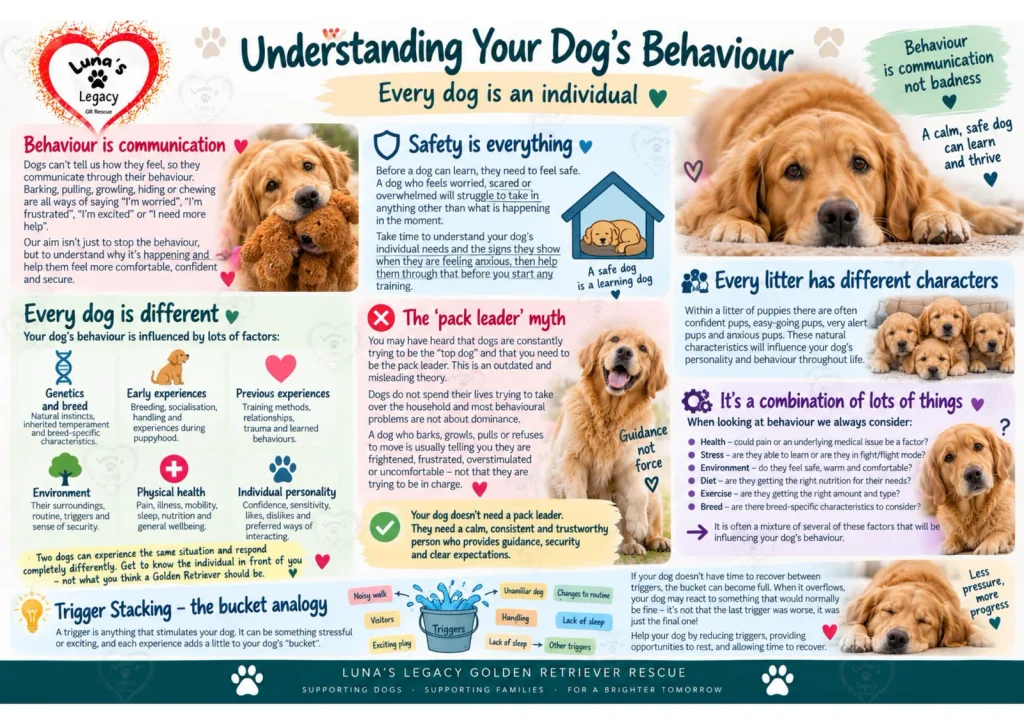
Behaviour Is Communication
One of the most important things to understand about your new rescue dog is that behaviour is communication.
Dogs cannot explain when they are frightened, frustrated, overwhelmed, uncomfortable or confused. Instead, they communicate through their body language and behaviour.
When working with a dog who displays challenging behaviours, our aim is not simply to stop the behaviour. We need to understand why it is happening and help the dog develop healthier, more appropriate ways of responding. This is particularly important for rescue dogs, some of whom may have experienced considerable upheaval, inconsistent handling, poor socialisation or previous trauma.
Before we can expect a dog to learn, we must first help them feel safe.
Every Dog Is an Individual
Your dog’s behaviour is influenced by a combination of factors, including:
- Genetics and breed: Natural instincts, inherited temperament and breed-specific characteristics.
- Early experiences: Breeding, socialisation, handling and experiences during puppyhood.
- Previous experiences: Training methods, relationships, frightening events and learned behaviours.
- Environment: Their surroundings, routine, sense of security and exposure to stressful situations.
- Physical health: Pain, illness, mobility, sleep, nutrition and general wellbeing.
- Individual personality: Confidence, sensitivity, likes, dislikes and preferred ways of interacting.
Two dogs can experience exactly the same situation and respond completely differently. One may be excited, another frightened, and a third completely uninterested.
The dog you have adopted is not the dog you owned previously, the dog next door or the dog you think a Golden Retriever should be.
Getting to know the individual in front of you is one of the most important parts of building a successful relationship.
Forget the ‘Pack Leader’ Myth
You may have heard that dogs are constantly trying to become the ‘alpha’ or that owners must establish themselves as the dominant pack leader. This is an outdated and misleading interpretation of canine behaviour. Dogs do not spend their lives plotting to take control of the household, and most behavioural problems are not attempts to challenge their owners’ authority.
A dog who growls when approached, pulls on the lead, refuses to move or reacts to another dog is not necessarily trying to be dominant. They may be frightened, frustrated, overstimulated, uncomfortable or simply responding in a way that has worked for them previously.
Punishing these behaviours without understanding their cause can increase anxiety, damage trust and potentially make the problem worse.
Your dog does not need you to be their pack leader.
They need you to be a calm, consistent and trustworthy person who provides guidance, security and clear expectations. This does not mean allowing your dog to do whatever they please. Boundaries, routines and appropriate behaviour are essential. However, these should be taught through consistency, positive reinforcement and sensible management rather than intimidation or fear.
Understanding Stress and Trigger Stacking
What Is Trigger Stacking?
Trigger stacking is one of the most important concepts for owners of rescue dogs to understand. A trigger is anything that causes an emotional or physiological response in your dog.
Triggers are not necessarily frightening. They can also be exciting or frustrating.
Examples include:
- Seeing another dog.
- Visitors arriving at the house.
- Travelling in the car.
- Hearing unexpected noises.
- Playing an exciting game.
- Meeting unfamiliar people.
- Being handled in an uncomfortable way.
- Changes to the household routine.
Each experience can increase your dog’s level of arousal or stress. Normally, with sufficient rest and recovery, those levels gradually return towards normal.
However, if several stimulating or stressful experiences occur close together, your dog may not have had enough time to recover before the next one arrives. This is known as trigger stacking.
The Bucket Analogy
Imagine your dog has a bucket.
Every stressful or exciting experience adds a little water.
A noisy walk adds some water.
An unfamiliar visitor adds some more.
A frightening encounter with another dog adds another large splash.
Eventually, the bucket overflows. At that point, something that your dog would normally cope with may suddenly produce an exaggerated reaction. This explains why a dog might walk past five other dogs perfectly happily, then suddenly bark and lunge at the sixth. The sixth dog may not have been particularly threatening. It was simply the final trigger that pushed your dog beyond their ability to cope.
How Long Does Stress Last?
Stress hormones, including adrenaline and cortisol, play an important role in preparing the body to respond to challenges. Recovery varies depending on the individual dog and the intensity and duration of the experience. Some dogs recover relatively quickly, while others may remain unsettled for considerably longer. There is no universal recovery period, and it is not possible to assume that every dog requires exactly 24, 48 or 72 hours.
For dogs experiencing chronic stress, recovery can take weeks or longer.
This is one reason we place such importance on decompression following adoption.
A dog who is constantly overwhelmed cannot be expected to learn or respond as effectively as one who feels safe and relaxed.
Recognising Trigger Stacking
Signs may include:
- Increased barking or reactivity.
- Restlessness or inability to settle.
- Excessive panting or pacing.
- Heightened sensitivity to sounds or movement.
- Difficulty concentrating.
- Increased mouthing or jumping.
- Frustration over seemingly minor things.
- Unusual clinginess or withdrawal.
- A reduced ability to respond to familiar cues.
If your dog suddenly appears to have forgotten everything they know, consider what they have experienced over the preceding hours or days.
Sometimes the most effective response is not more training, but less stimulation and more opportunity to rest.
Helping Your Dog Recover
When your dog is showing signs of stress:
- Reduce exposure to situations they find difficult.
- Provide a calm, predictable environment.
- Allow plenty of uninterrupted sleep and rest.
- Offer appropriate enrichment, such as sniffing, licking and gentle problem-solving activities.
- Avoid excessive excitement or demanding training sessions.
- Gradually reintroduce experiences as their confidence improves.
Remember that enrichment should be calming and enjoyable, not another source of frustration.