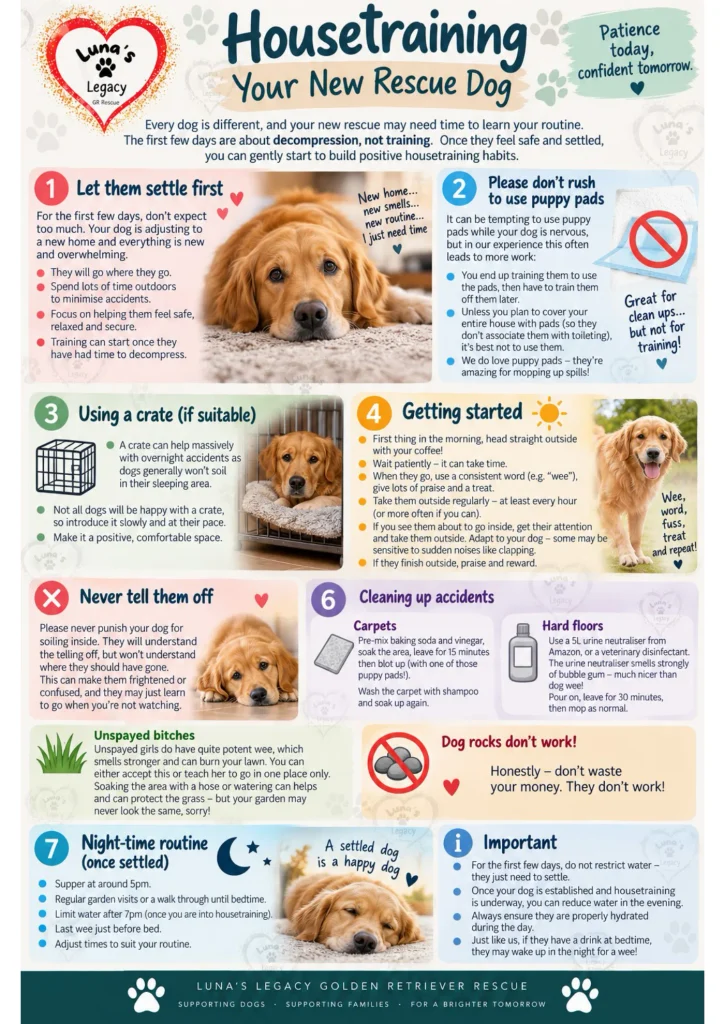
Let’s not run before we can walk.
For the first days, expect nothing from your newly arrived dog.
They will go where they go and trying to tackle it too quickly won’t have any impact.
It would be great if you can spend lots of time outdoors with them to minimise accidents, but the first few days are more about decompression and not training.
The temptation is to rush out and buy puppy pads and train your dog to use them while they are nervous and scared, then move them outside. In our experience this will most likely make you end up doing the job twice- once to train them onto the pads and once to train them off. We do love puppy pads; they are amazing for mopping up spills! But unless you are going to cover your entire house with them, so that they don’t associate them with toileting, you are best just using them for clean ups or not at all.
Once they are settled, if you can get them using a crate this will help massively with overnight accidents as they generally won’t soil in there. That being said, they might not be happy with a crate so take it all slowly and at their pace.
Getting started
First thing in the morning, pop your slippers on and head straight out into the garden.
And there you will stand with your coffee and wait and wait and wait!
Hopefully they will go outside and when they do,give lots of fuss, a good girl/boy and a treat. If you can use a word every time they go – even better.
If they don’t go after 30 mins or so, chalk it up and try again later.
Throughout the course of the day, pop outside every hour – or less if you can manage it.
Wee, word, fuss, treat and repeat.
Normally our advice would be if you see a dog about to go to the toilet in the house, clap to get their attention to stop them, and outside. Obviously with rescue dogs they might be a bit sensitive to sounds so adapt to your dog. Get their attention and take them outside. If they finish off outside, wee, word, fuss, treat.
Please never tell a dog off for soiling inside. They will understand the telling off, but they will think it’s for soiling, not for where they have done it so then they will just wait until you’re not watching and pee anyway.
For those inevitable accidents For wees on carpets, pre mix baking soda and vinegar and soak the carpet. Leave for 15 minutes then soak up (with one of those puppy pads you won’t be using). Wash carpet with shampoo and soak up again. For wees on hard floors, the best thing we have found is a 5L urine neutraliser on Amazon, or the veterinary disinfectant. The urine neutraliser smells very strongly of bubble gum which is far nicer than dog wee! Chuck it down, leave it for half an hour, then mop as normal
If your dog is an unspayed bitch, they do have quite potent wee. It does smell stronger than a spayed girl, and it will burn your lawn. You can either just accept it or teach her to go in one place only. Soaking the area she has weed in with a hose or watering can does help the grass too … if you can keep on top of it. But your garden will never look the same, sorry! Dog rocks- honestly don’t waste your money. They don’t work!
To reduce night-time accidents apply this routine once your dog is happy and settled.
Supper at around 5pm, garden visits or walk through until bedtime. As long as they are properly hydrated during the day, limit water after 7pm and then last wee just before you all go to bed (adjust times as required for early sleepers).
The temptation is to leave the water bowl full at all times, but just like we all wake up at 4am for a wee if we had a cup of tea at bedtime – so will they! However, for the first few days don’t implement the water restriction – she just needs to settle. Only do it once you’re into housetraining.