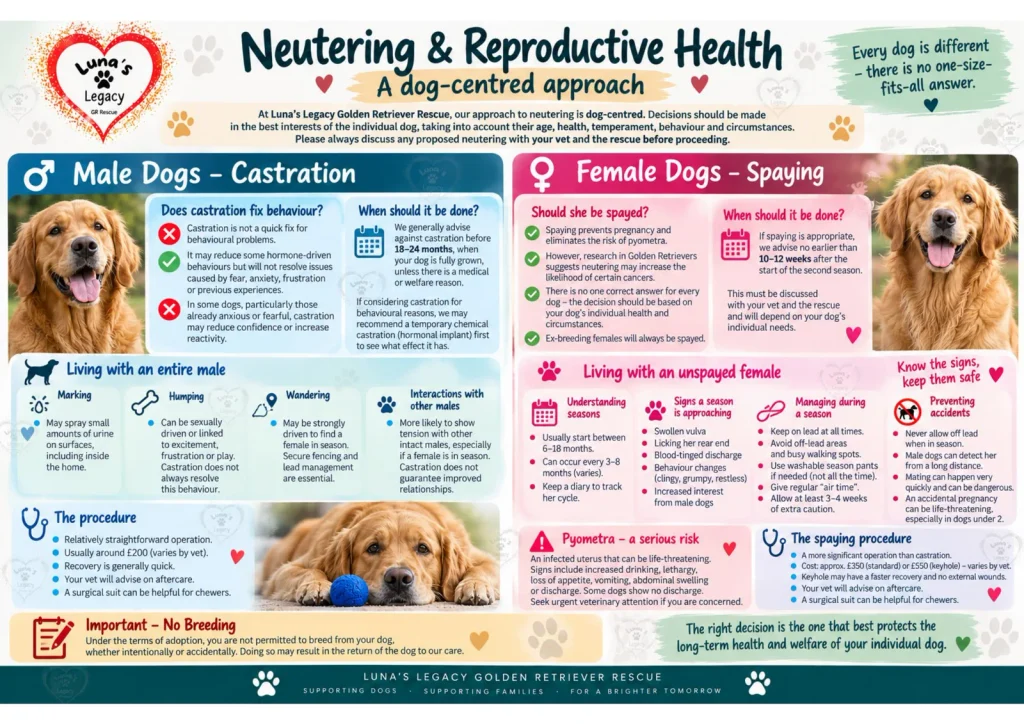
Our Approach to Neutering
At Luna’s Legacy Golden Retriever Rescue, our approach to neutering is veterinary led dog-centred, not one-size-fits-all.
We believe decisions about neutering should be made in the best interests of the individual dog, taking into account their age, physical development, health, temperament, behaviour and circumstances.
Golden Retrievers are a breed for which the timing and potential long-term effects of neutering deserve particular consideration. Research has identified associations between neutering, certain joint disorders and some cancers, although the risks vary depending on sex, age and individual circumstances.
Neutering also has important benefits, including preventing unwanted pregnancies and eliminating the risk of certain reproductive conditions.
We therefore ask that adopters discuss any proposed neutering with both their veterinary surgeon and the rescue before proceeding, in accordance with their adoption agreement. Our adoptions include strict anti breeding clauses which will, if breached, require the surrender of your dog back to the rescue.
Male Dogs
Should My Male Dog Be Castrated?
Castration involves the surgical removal of the testicles, eliminating the dog’s ability to reproduce and significantly reducing testosterone production.
It is important to understand that castration is not a universal solution to behavioural problems.
Many behaviours commonly attributed to testosterone, including reactivity, resource guarding, anxiety, overexcitement and poor manners, are not necessarily sexually driven.
Castration may reduce certain hormone-related behaviours, but it is unlikely to resolve behaviours that have developed through fear, frustration, learning or previous experiences.
In some dogs, particularly those already showing anxiety or fear-based behaviour, castration may have an undesirable effect on confidence or behaviour. However, the evidence is mixed, and outcomes vary between individuals. For this reason, we strongly recommend a veterinary and behavioural assessment before considering castration as a solution to an existing behavioural problem.
When Should Male Golden Retrievers Be Castrated?
Golden Retrievers are a large breed and take considerable time to reach physical maturity. Our general preference is to avoid routine castration before approximately 18–24 months, unless there is a compelling medical or welfare reason to proceed earlier. This is a guideline rather than an absolute rule. The appropriate timing should be determined with your vet, taking account of current evidence and your dog’s individual needs.
Where castration is being considered primarily for behavioural reasons, we may recommend discussing a temporary hormonal implant with your vet before committing to permanent surgery. This can sometimes provide useful information about how reducing testosterone might affect your dog, although it does not reliably predict every behavioural outcome of surgical castration.
Living With an Entire Male Dog
An entire (uncastrated) male can live a perfectly happy, healthy and well-adjusted life. However, there are some behaviours and responsibilities owners should be aware of.
- Urine Marking Some entire males will mark their territory by depositing small amounts of urine in different locations. This is normal canine communication, but occasionally marking can occur inside the home. Consistent housetraining, supervision and appropriate management can help. Castration may reduce hormonally driven marking, but it is not guaranteed to eliminate it.
- Mounting and Humping Mounting is not always sexual. Dogs of either sex may mount other dogs, people or objects because of excitement, stress, frustration, play or sexual arousal. It is not generally helpful to interpret mounting as an attempt to establish dominance. Castration may reduce sexually motivated mounting but will not necessarily resolve mounting caused by other factors.
- Wandering and Escaping Entire males may become highly motivated to seek out females in season. A female’s scent can travel considerable distances, and some males may become distracted, restless or determined to escape. Secure fencing, careful lead management and reliable supervision are essential. Never assume that good recall will override a strong sexual motivation.
- Interactions With Other Male Dogs Some entire males may experience tension or conflict with other males, particularly in the presence of a female in season. However, aggression between dogs is complex and cannot simply be attributed to testosterone. Castration does not guarantee improved relationships with other dogs and should not be relied upon as a treatment for aggression.
The Castration Procedure
Surgical castration is generally a routine veterinary procedure, usually performed under general anaesthetic. Most dogs recover well, although they will require restricted activity, appropriate pain relief and wound monitoring during recovery. Your vet will provide specific aftercare instructions, including how to prevent licking or chewing of the surgical site. A properly fitted surgical recovery suit or protective collar may be recommended. Costs vary considerably between veterinary practices, so please request an estimate directly from your vet.
Female Dogs
Should My Female Golden Retriever Be Spayed?
Spaying prevents pregnancy and eliminates the risk of pyometra, a potentially life- threatening infection of the uterus. It also removes the risk of ovarian disease when the ovaries are removed and may influence the risk of mammary tumours, although the strength of the evidence for cancer prevention varies.
However, research involving Golden Retrievers has raised concerns about strong causal associations between neutering and certain cancers and joint disorders. Some breed-specific studies suggest that leaving female Golden Retrievers entire may be a reasonable option in certain circumstances, provided their owners understand and can manage the associated reproductive health risks. There is no universally correct decision for every female Golden Retriever. The potential benefits of spaying must be balanced against the possible disadvantages of surgery, hormone removal and the dog’s individual health circumstances.
At Luna’s Legacy, we prefer to consider each female individually rather than automatically recommending routine spaying. Dogs with a history of breeding have different medical considerations, and will require neutering at the earliest appropriate opportunity.
When Should a Female Be Spayed?
If spaying is considered appropriate, our preference is to allow the dog to reach physical maturity and, where suitable, experience at least two seasons before surgery. However, this must be balanced against the risk of accidental pregnancy, pyometra and any individual medical concerns.
Spaying is normally scheduled when a female is not in season, commonly around two to three months after a season has finished, although your vet will determine the safest timing.
Please discuss the proposed timing with your vet and the rescue.
Living With an Unspayed Female
Keeping a female dog entire requires additional care, planning and responsible management.
Understanding Seasons Most female dogs experience their first season between approximately six and eighteen months of age, although some large-breed dogs may be older. Once established, seasons commonly occur around every six to eight months, but there is considerable individual variation. We recommend recording the start and end of every season so you can begin to recognise your dog’s normal cycle.
Signs Your Dog Is Coming Into Season You may notice:
- Swelling of the vulva.
- Increased licking around her rear end.
- Blood-tinged discharge or spotting.
- More frequent urination.
- Changes in appetite or behaviour.
- Increased clinginess, restlessness or irritability.
- Greater interest from male dogs.
Some females experience very obvious seasons, while others show relatively subtle signs. The amount of bleeding also varies considerably.
Managing Your Dog During Her Season Most females are very good at keeping themselves clean, but you may notice spotting on bedding, carpets or floors. Washable dog season pants can be useful for protecting furniture and flooring. However, they should be changed regularly and removed frequently to allow the skin to remain clean and dry. Season pants do not prevent mating or pregnancy and must never be relied upon as contraception. Your dog should also have regular opportunities to toilet and clean herself without wearing them.
Walking During a Season Female dogs can continue to enjoy appropriate exercise during their season, but additional precautions are essential.
- Keep your dog on a secure lead at all times.
- Avoid off-lead areas, dog parks and busy dog-walking locations.
- Choose quieter routes and times of day.
- Avoid greetings with unfamiliar dogs, particularly entire males.
- Never leave your dog unattended in the garden, even behind fencing.
- Ensure doors, gates and boundaries are secure.
Male dogs may detect a female in season from a considerable distance, and even normally well-behaved dogs can become highly motivated to reach her. A female may remain fertile after her bleeding has reduced or stopped. As a general precaution, maintain strict separation from entire males for at least three to four weeks from the start of the season, and longer if signs of the season continue or your vet advises it. If you are unsure whether your dog’s season has finished, continue taking precautions.
Preventing Pregnancy Never allow your female dog off lead while she is in season, regardless of how reliable her recall normally is. Mating can happen very quickly. If dogs become tied during mating, never attempt to forcibly pull them apart. This can cause serious injuries to both animals. Contact your veterinary surgeon IMMEDIATELY for advice if a mating occurs as they can administer an injection to prevent implantation. Pregnancy in an immature female can carry additional welfare and health risks, and no adopted rescue dog should be allowed to breed. *Please note that under Luna’s Legacy Adoption Contract Terms & Conditions, any female who is allowed to become pregnant, whether accidentally or intentionally must be returned to the rescue.
Pyometra – An Important Health Warning
Pyometra is a serious infection of the uterus that can affect unspayed female dogs, particularly as they get older. It can develop in the weeks following a season and may become life-threatening very quickly.
Signs can include:
- Drinking or urinating more than usual.
- Lethargy or unusual tiredness.
- Loss of appetite.
- Vomiting.
- Abdominal swelling or discomfort.
- Unusual discharge from the vulva. Importantly, some dogs develop pyometra without any visible discharge.
If your unspayed female becomes unwell, particularly within the weeks following a season, seek urgent veterinary attention. Pyometra is a veterinary emergency and should never be left to see whether symptoms improve.
The Spaying Procedure
Spaying is abdominal surgery performed under general anaesthetic. Depending on the veterinary practice and your dog’s individual circumstances, it may be carried out using traditional open surgery or a laparoscopic (keyhole) technique. Laparoscopic surgery generally involves smaller incisions