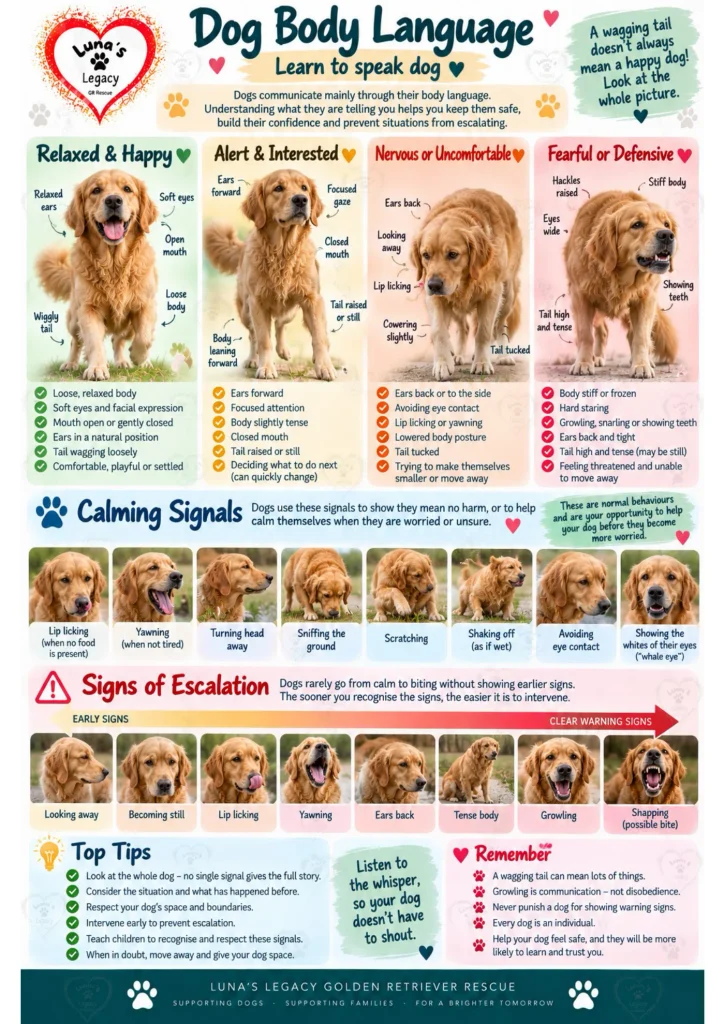
Learning to Speak Dog
Dogs communicate primarily through body language.
While they may bark, growl or whine, much of what they are telling us is communicated through their posture, facial expressions, ears, eyes, tail and movements.
Learning to recognise these signals is one of the most important things you can do for your new rescue dog.
Understanding body language allows you to recognise when your dog is happy and relaxed, but more importantly, when they are becoming uncomfortable, anxious, frightened or overwhelmed.
This means you can intervene before a situation escalates, helping your dog feel safer and preventing potentially difficult or dangerous situations.
Always Look at the Whole Dog
Dog body language is highly contextual.
No single signal tells you exactly how a dog is feeling.
For example, a wagging tail does not automatically mean a happy dog. Tail wagging can indicate excitement, uncertainty, frustration or even a warning to keep your distance.
Similarly, a dog showing its teeth may be displaying a warning, while another may be offering a submissive-looking grin.
Always consider the dog’s entire body, the situation they are in and what has happened immediately beforehand.
Recognising Different Emotional States
1. Relaxed and Happy A comfortable, relaxed dog will generally have:
- – A loose, soft and wiggly body.
- – Relaxed muscles and natural movements.
- – Soft eyes and a relaxed facial expression.
- – Ears held naturally rather than rigidly.
- – A relaxed mouth, sometimes gently open.
- – A tail moving loosely or resting in its natural position.
- – The ability to move away, explore or settle comfortably.
Happy dogs generally look comfortable in their own skin.
However, even a relaxed dog can become uncomfortable if something changes.
Continue paying attention to their body language, particularly during introductions, handling and unfamiliar experiences.
2. Nervous, Anxious or Uncomfortable Dogs often communicate discomfort through subtle signals long before they bark, growl or attempt to bite. These can include:
- – Lip licking when no food is present.
- – Yawning when they are not tired.
- – Turning their head or or body away.
- – Avoiding eye contact.
- – Showing the whites of their eyes (whale eye).
- – Ears moving backwards or flattening.
- – A lowered body posture or tucked tail.
- – Becoming unusually still.
- – Sniffing the ground or suddenly scratching.
- – Moving away, hiding or seeking distance.
Some of these behaviours are described as appeasement signals or displacement behaviours. They may indicate that a dog is experiencing uncertainty, emotional conflict or stress, although they can also occur in completely normal circumstances.
For example, a dog who suddenly begins sniffing the ground when another dog approaches may be trying to avoid an uncomfortable interaction.
These quiet signals are your opportunity to help your dog before they feel the need to communicate more forcefully.
3. Alert and Assessing An alert dog has noticed something and is deciding how to respond. You may notice:
- Ears moving forward.
- A raised head.
- A closed mouth.
- Focused attention or staring.
- A body leaning forward or becoming more upright.
- A raised or still tail.
- Reduced movement or sudden stillness.
Being alert is not necessarily negative. Your dog may simply be curious or interested.
However, alertness can quickly develop into excitement, fear, frustration or defensive behaviour. Watch what happens next.
If your dog’s body relaxes, they are probably comfortable. If they become increasingly stiff, fixated or tense, it may be time to create some distance.
4. Fearful or Defensive When a dog feels threatened or unable to escape, their body language may become much more obvious. Warning signs can include:
- A rigid or frozen body.
- Hard staring.
- Growling or snarling.
- Showing teeth.
- A tightly closed mouth.
- Raised hackles along the back.
- A tense or unusually high tail.
- Lunging, snapping or attempting to bite.
Not every frightened dog will show all these signs. Some will retreat, some will freeze, and others may react defensively. Raised hackles are a sign of arousal, not necessarily aggression, and may also appear during excitement.
A growl is communication, not disobedience. Never punish your dog for growling. Growling is often a warning that the dog is uncomfortable and needs more space. Punishing the warning can result in a dog who no longer gives such obvious signals before reacting.
If your dog shows defensive behaviour, stop the interaction, avoid reaching towards them and calmly create distance. Do not stare, corner, chase or attempt to force contact. If you encounter an unfamiliar dog showing threatening behaviour, avoid sudden movements and calmly move away when it is safe to do so.
Understanding the Escalation of Behaviour
Dogs will often communicate discomfort through increasingly obvious signals if their earlier attempts are unsuccessful. For example, a dog who is uncomfortable being hugged might:
- Turn their head away.
- Lick their lips or yawn.
- Become still or tense.
- Show the whites of their eyes.
- Growl.
- Snap or bite if they feel unable to escape.
Not every dog follows this sequence, and some may escalate very quickly or with little obvious warning.
Previous experiences, fear, pain and learned behaviour can all influence how a dog responds. This is why recognising the earliest signs is so important. The aim is to intervene at the head turn or lip lick, not wait until the growl or snap.
Respecting Your Dog’s Boundaries
Your new rescue dog may have experiences, sensitivities or fears that you do not yet understand. They may be uncomfortable with:
- Being hugged or restrained.
- People leaning over them.
- Hands reaching towards their face.
- Being disturbed while sleeping.
- Having their collar grabbed.
- Being approached while eating.
- Unfamiliar people touching them.
- Other dogs entering their personal space.
Never assume that because your dog tolerated something yesterday, they will necessarily be comfortable with it today.
Stress, tiredness, pain and changes in their environment can all affect how much they can cope with.
Allow your dog to make choices wherever it is safe to do so.
If they move away from affection, let them go.
If they are resting, leave them undisturbed.
If they are worried about something, give them space.
Respecting these boundaries helps build trust and reduces the likelihood of defensive behaviour.
Children and Dog Body Language
Children are particularly likely to miss subtle signs of discomfort, and dogs may find their unpredictable movements, noise and enthusiasm overwhelming.
Adults must always supervise interactions between children and dogs.
Teach children never to:
- Hug, climb on or lie across a dog.
- Disturb a dog who is sleeping or eating.
- Take food, toys or chews away.
- Follow a dog who is trying to move away.
- Put their face close to a dog’s face.
- Corner or restrain a dog.
A dog who is tolerating attention is not necessarily enjoying it.
If a dog becomes still, turns away, licks their lips, shows the whites of their eyes or attempts to leave, calmly end the interaction.
Never leave children and dogs together unsupervised, regardless of how gentle or trustworthy the dog appears.
Prevention Is Better Than Reaction
One of the most valuable skills you can develop is learning to recognise when your dog is beginning to struggle. Rather than waiting for barking, lunging, growling or snapping, look for the small changes in body language that tell you something is wrong.
If you recognise discomfort early, you can:
Give your dog more space.
Remove them from an uncomfortable situation.
Prevent unwanted interactions.
Redirect their attention where appropriate.
Allow them time to recover.
Help them build more positive associations with difficult experiences.
The more consistently you respond to these early signals, the more your dog can learn that you will listen and help keep them safe.
Our Most Important Advice
Listen to the whisper, so your dog doesn’t have to shout.
Dogs rarely begin with their loudest form of communication. Many will offer quieter signals first, but these can be missed, misunderstood or ignored. A dog who feels that their early warnings are consistently respected may have less reason to escalate. Your job is not to suppress communication. It is to understand it. The better you become at reading your dog’s body language, the more effectively you can support them, build their confidence and strengthen your relationship.
And remember, if your dog is showing behaviour that concerns you, particularly growling, snapping or biting, please contact Luna’s Legacy Golden Retriever Rescue for guidance.
A dog who feels heard is a dog who is more likely to feel safe.