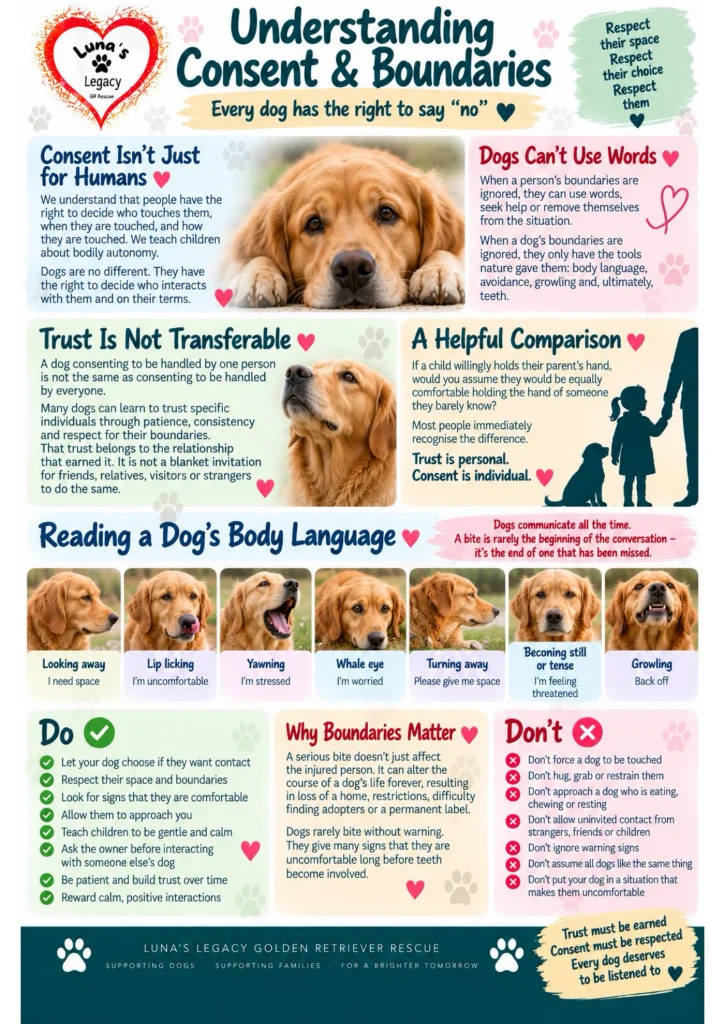
Consent Is Not a Concept Reserved for Humans
We understand that people have the right to decide who touches them, when they are touched, and how they are touched.
We teach children about bodily autonomy.
We recognise that forcing physical contact on someone who is uncomfortable can lead to fear, distress, or a defensive reaction.
Dogs are no different.
The difference is that when a person’s boundaries are ignored, they can use words, seek help, or remove themselves from the situation.
When a dog’s boundaries are ignored, they only have the tools nature gave them: body language, avoidance, growling, and ultimately, teeth.
Trust Is Not Transferable
A dog consenting to be handled by one person is not the same as consenting to be handled by everyone.
Many dogs can learn to trust specific individuals through patience, consistency, and respect for their boundaries. However, that trust belongs to the relationship that earned it. It is not a blanket invitation for friends, relatives, visitors, or strangers to do the same.
This is why some dogs require a strict ‘No Uninvited Contact’ policy.
These policies are not about being difficult or antisocial. They exist because certain dogs need control over who enters their personal space and who touches them.
A Helpful Comparison If a child willingly holds their parent’s hand, would you assume they would be equally comfortable holding the hand of someone they barely know? Most people immediately recognise the difference.
Trust is personal.
Consent is individual.
Dogs deserve the same consideration.
Why Boundaries Matter
A serious bite does not just affect the injured person. It can alter the course of a dog’s life forever.
One incident may result in loss of a home, restrictions on future freedoms, difficulty finding adopters, or a permanent label that follows the dog wherever they go.
Dogs rarely bite without warning.
They communicate through avoidance, turning away, lip licking, yawning, freezing, increased tension, whale eye, growling, moving away, and other displacement behaviours long before teeth become involved.
A bite is rarely the beginning of the conversation. More often, it is the end of a conversation that has been missed, misunderstood, or ignored.
Dogs are communicating with us all the time.
The question is not whether they are giving consent. The question is whether we are listening.
Respecting a dog’s boundaries is not optional. It is a fundamental part of responsible dog ownership. Trust must be earned. Consent must be respected. Every dog deserves to be listened to.