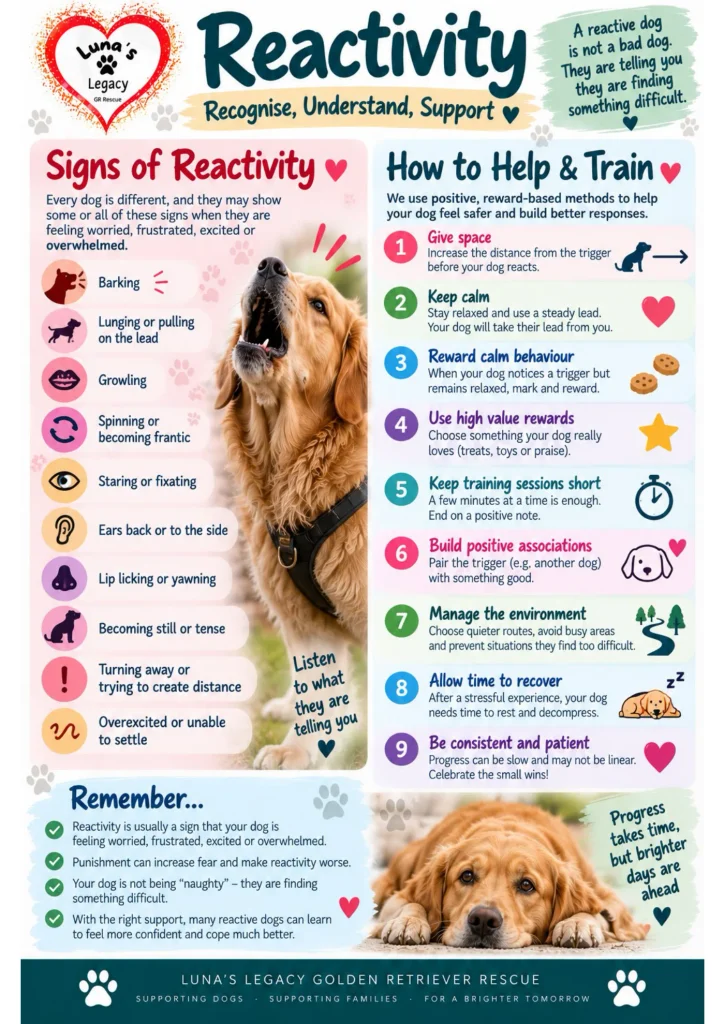
What Is a Reactive Dog?
Reactivity describes an unusually intense response to something in the environment.
This may include:
- Barking.
- Lunging.
- Growling.
- Pulling towards or away from something.
- Spinning, jumping or becoming frantic.
- Fixating on another dog, person or object.
Reactivity can be driven by fear, frustration, excitement or a combination of emotions.
A reactive dog is not automatically an aggressive dog.
Some dogs react because they want something to move away.
Others react because they desperately want to approach it but are prevented from doing so.
However, reactive behaviour can escalate into aggression, particularly if a dog feels trapped or repeatedly pushed beyond their comfort level. It must therefore be taken seriously and managed appropriately.
Reactivity Is Often Context-Specific
A dog may be perfectly comfortable around other dogs when off lead but become reactive when restrained. Another may cope well with people outdoors but bark intensely when visitors enter their home. Some dogs react only in busy environments, while others become distressed by very specific sights or sounds.
Your job is to identify the situations in which your dog struggles and understand what makes those situations difficult.
Recognising Early Warning Signs
Dogs usually communicate discomfort before they begin barking or lunging.
Early signs can include:
- Suddenly becoming still or stiff.
- Closing their mouth and staring.
- Turning their head away.
- Lip licking or yawning.
- Ears moving backwards.
- A lowered or tense body posture.
- Trying to increase distance.
- Becoming unusually alert or fixated.
These signals must always be interpreted in context. The earlier you recognise that your dog is uncomfortable, the easier it is to prevent the situation escalating.
Managing Reactivity on Walks
Prevention Is Better Than Reaction
The most effective way to manage reactivity is to recognise potential problems before your dog reaches the point of barking, lunging or losing control.
During the early stages of training:
- Choose quiet walking locations.
- Avoid crowded areas and busy dog-walking routes.
- Remain aware of approaching people, dogs and other triggers.
- Create distance before your dog becomes uncomfortable.
- Avoid narrow paths where your dog cannot move away.
- Keep your own behaviour calm and predictable.
- Reward your dog for noticing something and remaining relaxed.
Do not deliberately expose your dog to situations they find overwhelming in the hope that they will eventually get used to them.
Repeated exposure without appropriate management can make fear and reactivity worse.
Distance Is Your Friend
If your dog reacts to other dogs, there will usually be a distance at which they can see another dog without becoming overwhelmed.
This is the distance at which you should begin working.
For some dogs, that might be ten metres. For others, it could be the length of an entire field.
There is no correct distance.
Your individual dog will determine what they can comfortably manage.
As their confidence improves, you can gradually work at closer distances.
Progress should be measured by how comfortably your dog can cope, not how close you can force them to get to a trigger.