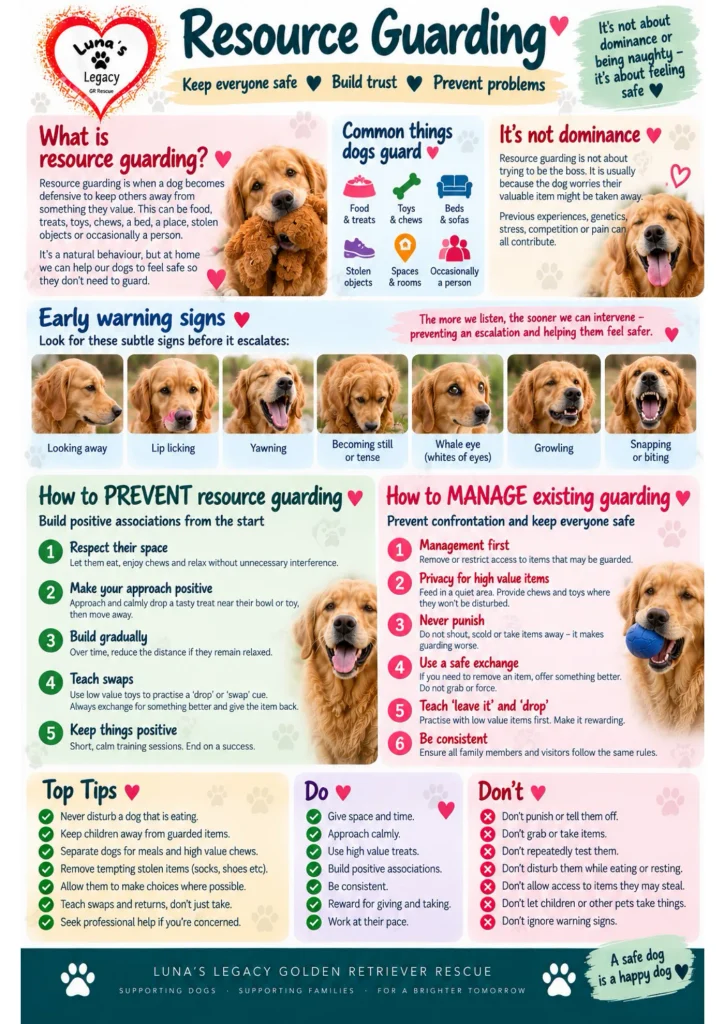
What Is Resource Guarding?
Resource guarding is when a dog becomes protective or defensive over something they consider valuable and attempts to prevent another animal or person from approaching, touching or taking it away.
The resource might be:
- Food, food bowls or treats.
- Chews, bones or other edible items.
- Toys, balls or favourite possessions.
- Stolen objects such as socks, shoes or household items.
- Beds, sofas or favourite resting places.
- Particular rooms, doorways or areas of the home.
- Occasionally, a person or access to their attention.
Resource guarding is a natural canine behaviour. In evolutionary terms, protecting access to valuable resources can be an important survival strategy.
However, in a domestic environment, guarding can become problematic and potentially dangerous, particularly when it involves growling, snapping or biting.
The most important thing to understand is that resource guarding is not about dominance, being naughty or trying to become the boss of the household.
It is usually about the dog’s desire to retain something they value, often combined with concern that it may be taken away.
Our aim is not to teach a dog that they must surrender everything to us.
It is to help them feel secure enough that they no longer need to defend their possessions.
Why Do Dogs Resource Guard?
There is rarely one single explanation. Resource guarding can develop because of:
- Genetics and natural behaviour: Some dogs have a greater natural tendency to retain or protect valued resources than others.
- Previous experiences: Dogs who have repeatedly had food, toys or other possessions forcibly removed may learn that people approaching means they are about to lose something valuable.
- Competition: Living with other dogs, particularly where food or possessions have been contested, can contribute to guarding.
- Stress and insecurity :Dogs who feel unsettled, anxious or uncertain about their environment may become more protective of things they value.
- Learned behaviour: If growling causes someone to move away, the dog learns that growling successfully protects their resource. This does not mean the dog is deliberately manipulating you. They are simply repeating a behaviour that has worked.
- Pain or medical problems: Physical discomfort can reduce a dog’s tolerance of being approached or disturbed.
Sudden changes in guarding behaviour should always prompt consideration of a veterinary assessment.
A Particular Consideration for Rescue Dogs
Some dogs arriving in rescue have experienced repeated confrontation over possessions. They may have learned that taking an object results in someone chasing them, shouting, grabbing their collar or forcibly removing it.
Others may have had very little opportunity to enjoy food or toys without interference.
For these dogs, guarding may be an established response to situations they perceive as threatening.
Your dog may not yet understand that living with you means their food is secure, their possessions are safe and nobody is going to take things away unnecessarily.
Building that trust takes time.
Recognising the Early Warning Signs
Resource guarding does not always begin with growling. In fact, some of the most important signals are much quieter. Watch for:
- Suddenly becoming still or freezing.
- Eating faster when someone approaches.
- Lowering their head over a food bowl or object.
- Turning their body away to protect an item.
- Moving away with a possession.
- Holding an object tightly in their mouth.
- Stiffening when someone approaches.
- Hard staring or showing the whites of their eyes.
- Placing their body between a person and an object.
- Growling, snarling or showing teeth.
- Snapping, lunging or biting.
Some dogs may appear completely relaxed until someone reaches towards the resource.
Others may actively approach a person with an object, then become defensive if the person attempts to take it.
Never assume that because a dog has not growled, they are comfortable with what you are doing.
Learn to recognise the earliest changes in body language and respond before the situation escalates.
The Golden Rules of Resource Guarding
1. Never Punish Guarding
Punishment can reinforce the dog’s belief that people approaching their possessions are a threat. It may also suppress warning behaviours such as growling without addressing the underlying emotion. A dog who has learned not to growl may still feel threatened and could progress to snapping or biting with less obvious warning.
Do not shout, scold, intimidate, physically correct or punish a dog for guarding.
A growl is valuable communication. Listen to it.
2. Never Forcibly Remove an Item
Do not grab objects from your dog’s mouth, pry their jaws open, drag them away by their collar or physically confront them over possessions. These actions can increase guarding and create a serious bite risk.
If an item must be removed, use a safe, previously practised exchange or seek professional advice.
3. Manage the Environment
Prevention is essential.
- If your dog is likely to steal and guard socks, do not leave socks accessible.
- If they guard chews, provide them only in a safe, separate area where they will not be disturbed.
- If they guard the sofa, manage access while working on an appropriate behaviour plan.
- Every confrontation you prevent is an opportunity to avoid reinforcing the guarding behaviour.
4. Teach That People Approaching Means Good Things
We want your dog to learn that people approaching their possessions does not automatically mean those possessions will disappear.
For dogs without established guarding behaviour, carefully managed positive experiences can help maintain a relaxed attitude towards people being nearby.
For dogs who already guard, this process should be guided by an appropriately qualified behaviour professional.
5. Respect Their Space
Dogs should be able to eat, rest and enjoy appropriate possessions without unnecessary interference.
You do not need to repeatedly touch your dog’s food bowl, take their toys or test whether they will tolerate you removing things.
Trust is built through predictability, not by repeatedly testing your dog’s tolerance.
Preventing Resource Guarding
Building Positive Associations Around Food
For dogs who are relaxed around food and have no history of guarding, you can help reinforce the idea that people approaching their feeding area is a positive experience.
Step 1 – Establish a Safe Feeding Routine
- Feed your dog in a quiet location where they will not be disturbed.
- If you have other pets, feed them separately.
- Allow your dog to finish eating without interruption.
- Avoid standing over them, touching their bowl or repeatedly walking past while they eat.
Step 2 – Make Your Presence Positive
- At a distance where your dog remains completely relaxed, occasionally toss an extra tasty treat towards their feeding area and continue moving away.
- Your dog should not feel the need to stop eating, stiffen, speed up or protect their bowl.
- If they show any signs of discomfort, stop the exercise and give them more space.
Step 3 – Build Trust Gradually
- Over repeated sessions, your dog may begin to associate your presence with something pleasant.
- The goal is for your dog to remain relaxed when people are nearby.
- You do not need to progress to touching, lifting or interfering with the bowl.
- A dog who eats happily without being disturbed is already demonstrating the outcome we want.
Important Safety Note:
If your dog has previously growled, frozen, snapped or bitten around food, do not attempt this exercise without professional guidance. Even apparently mild guarding can escalate if the dog feels pressured.
For established food guarding, the safest approach is to provide complete privacy during meals.
Preventing Guarding Around Toys and Chews
Dogs should be able to enjoy their possessions without constantly worrying that someone will take them away.
To help maintain a positive relationship with toys:
- Provide toys appropriate for your dog’s size and chewing habits.
- Allow them to enjoy toys without unnecessary interruption.
- Avoid repeatedly taking toys away to demonstrate control.
- Practise voluntary exchanges using low-value objects when your dog is relaxed.
- Frequently return exchanged items so your dog learns that releasing something does not always mean losing it.
- Provide high-value chews in a quiet location where your dog can remain undisturbed.
If your dog is already guarding toys or chews, do not approach them to practise exchanges without an individual behaviour plan.
Teaching a Reliable ‘Drop’ and ‘Swap’
One of the most useful skills you can teach any dog is to voluntarily release an object. We strongly recommend teaching this before you encounter a situation where you genuinely need your dog to give something up.
Step 1 – Start With Something Unimportant
- Choose a low-value toy that your dog enjoys but is not particularly possessive over.
- Allow them to hold it.
- Present a treat that is more appealing than the toy.
- When your dog voluntarily releases the toy to take the treat, reward them immediately.
- Do not pull the toy from their mouth.
Step 2 – Introduce a Cue
- Once your dog is consistently choosing to release the toy, introduce a verbal cue such as ‘Drop’ or ‘Swap’.
- Say the cue once, then offer the reward.
- Over time, your dog should begin associating the cue with voluntarily releasing the item.
Step 3 – Give the Toy Back
Where safe and appropriate, return the toy after rewarding your dog. This is particularly important. Your dog needs to learn that giving something up does not always mean losing it forever.
Step 4 – Practise With Different Objects
- Gradually practise with a variety of safe, low-value objects.
- Keep sessions short and enjoyable.
- Do not suddenly increase the difficulty by attempting to remove your dog’s favourite chew or a highly prized stolen object.
- If your dog becomes reluctant to release an item, you have probably progressed too quickly. Return to an easier exercise.
Teaching ‘Leave It’
‘Leave it’ is another valuable skill. Unlike ‘Drop’, which asks a dog to release something already in their mouth, ‘Leave it’ teaches them to disengage from something before picking it up. Begin with low-value objects and reward your dog for choosing to move away. Gradually build the behaviour in different environments.
Both cues can be extremely useful, but neither should be relied upon as a guaranteed way of resolving established resource guarding.
Managing Established Resource Guarding
If your dog already guards resources, the priority is to prevent confrontations while seeking appropriate support.
Food Guarding
- Feed your dog in a separate, quiet room.
- Keep children and other animals away during meals.
- Do not approach, touch or remove their bowl while they are eating.
- Wait until they have finished and voluntarily left the area before collecting the bowl.
- Do not attempt to hand-feed or interfere with their meals as a way of establishing control.
- Ensure all household members understand the rules.
For some dogs, these simple management arrangements may be all that is required to allow them to eat safely and comfortably. There is no requirement for every dog to tolerate someone putting their hands into their food bowl.
Guarding Chews and Toys
- If your dog guards particular toys or chews, consider whether those items need to be available at all.
- High-value chews should only be provided in a secure, separate area where nobody will need to approach or remove them.
- Avoid giving guarded items when visitors or children are present.
- If your dog has a serious history of guarding, it may be safer to withhold certain items until a professional behaviour plan has been established.
Guarding Stolen Objects
This is particularly common in young Golden Retrievers.
Socks, shoes, tea towels, remote controls and children’s toys can suddenly become the most valuable possessions in the world.
Unfortunately, chasing a dog around the house to retrieve a stolen item can turn the entire situation into a highly rewarding game. For some dogs, repeated confrontation can eventually develop into guarding.
The best strategy is to prevent access to objects you do not want your dog to have.
- Keep floors clear, laundry secured and tempting possessions out of reach.
- If your dog takes something harmless, avoid chasing, shouting or attempting to grab it.
- Where safe, use a familiar exchange cue or encourage them away from the object with something more rewarding.
- Only retrieve the item when you can do so without confrontation.
What If Your Dog Has Something Dangerous?
This requires particular care.
Examples include medication, sharp objects, batteries, cooked bones or items that could cause choking or intestinal obstruction.
- Do not put your hands into the mouth of a guarding dog or attempt to physically wrestle the item away.
- If your dog will voluntarily leave the item for a highly valued reward, and you can safely separate them from it, this may provide an opportunity to retrieve it.
- However, do not approach or attempt an exchange if the dog is showing threatening behaviour and doing so would place you at risk.
- Contact your vet or an emergency veterinary service immediately if your dog has swallowed, or may swallow, something dangerous.
- Do not induce vomiting unless specifically instructed by a veterinary professional.
If there is an immediate serious risk to either the dog or a person, prioritise safety and seek urgent professional assistance.
Guarding Beds, Sofas and Resting Places
Some dogs become protective of particular resting places. This may be because they value the comfort, feel secure in that location or are worried about being disturbed. Signs may include stiffening, growling or snapping when someone approaches or attempts to move them.
Safe Management
- Never drag a guarding dog off furniture by their collar.
- Do not physically push or pull them from a resting place.
- Provide comfortable alternative beds in quiet locations.
- Teach a positive ‘Off’ or ‘Bed’ cue away from guarding situations.
- Reward your dog for voluntarily moving to their own resting area.
- Manage access to furniture where necessary, before the dog settles there.
- Do not disturb a sleeping dog.
- If your dog guards a bed or sofa, avoid situations where someone needs to physically remove them.
- Use barriers or controlled access to prevent conflict while obtaining professional advice.
Guarding People
Occasionally, a dog may appear to guard a particular person.
For example, they may growl when another dog approaches their owner or become defensive when someone attempts to sit beside them.
This behaviour is sometimes mistaken for affection, jealousy or protectiveness.
However, it may reflect anxiety, competition over access to attention, learned behaviour or other underlying concerns.
What You Can Do
- Avoid encouraging possessive behaviour.
- Do not allow the dog to repeatedly block access to people.
- Manage interactions with other dogs and visitors.
- Reward relaxed behaviour when others are nearby.
- Provide predictable individual attention.
- Use barriers or separate spaces where necessary.
- Do not physically push a guarding dog away from the person they are protecting.
Because person-directed guarding can create a significant bite risk, we recommend seeking qualified behavioural advice rather than attempting to resolve it through confrontation.
Resource Guarding in Multi-Dog Households
Dogs who live together do not automatically want to share everything.
Even dogs who are the best of friends may become defensive over food, chews, toys or resting places.
Competition can develop gradually, particularly when a new dog joins the household.
Our Recommendations
- Always feed separately. Each dog should have their own feeding space, ideally behind a closed door or secure barrier.
- Do not allow one dog to approach another’s food bowl.
- Separate for high-value chews.
- Never assume that dogs who happily play together will also happily share bones or chews.
- Manage toys carefully. If toys create competition, remove them from shared areas and provide individual play sessions instead.
- Provide sufficient resting areas. Every dog should have somewhere they can rest without being approached or disturbed by another dog.
- Watch for subtle guarding. Blocking access, hard staring, hovering over objects or repeatedly displacing another dog may indicate developing tension.
- Do not allow dogs to ‘sort it out themselves’. Conflict over resources can escalate rapidly and result in serious injuries.
If your dogs are showing signs of resource-related tension, separate them appropriately and contact the rescue for advice.
Resource Guarding and Children
Children should never be expected to manage resource guarding.
Even a dog who has never bitten may react defensively if a child approaches their food, takes a toy or disturbs them while resting. Children may also miss subtle warning signs and are particularly vulnerable to serious injuries.
Our rules are simple:
- Children must never approach a dog who is eating or enjoying a chew.
- Children must never attempt to remove food, toys or stolen objects.
- Children must not disturb a dog who is sleeping or resting.
- Children must not hug, corner or physically restrain a dog.
- Adults must supervise interactions and use physical separation whenever active supervision is not possible.
- If a dog has a history of guarding accompanied by growling, snapping or biting, physical separation from children around potential resources is essential.
- Baby gates, separate rooms and secure feeding arrangements should be used as appropriate.
- Never rely on a child’s ability to remember instructions as the only safety measure.
- We will never rehome a known resource guarder into a house with young children
What If Your Dog Growls or Snaps?
If your dog growls, freezes, snarls or snaps when approached:
- Stop what you are doing.
- Do not reach towards the dog or the resource.
- Avoid direct confrontation.
- Calmly increase distance where safe.
- Keep other people and animals away.
- Allow the dog to settle without further interference.
- Make a note of what happened and the circumstances.
- Contact the rescue for advice.
- Do not immediately attempt to repeat the situation to see whether the dog reacts again.
- Never deliberately test a dog’s guarding behaviour.
- If a bite occurs, ensure the person receives appropriate medical attention. Dog bites that break the skin should be assessed by a healthcare professional because of infection and injury risks.
- Do not attempt further training exercises involving the guarded resource until the situation has been professionally assessed.
When to Seek Professional Help
Resource guarding exists on a spectrum.
Some dogs simply prefer to eat undisturbed.
Others may growl when someone approaches a valued possession.
At the more serious end, dogs may lunge, snap, bite or actively move towards someone to prevent access to a resource.
Professional support is particularly important if your dog:
- Has bitten or attempted to bite.
- Guards several different types of resources.
- Guards people or access to spaces.
- Shows little warning before reacting.
- Guards items from other household pets.
- Lives with children or vulnerable adults.
- Is becoming increasingly defensive.
- Causes household members to feel unsafe.
We recommend a veterinary assessment to rule out pain or other medical contributors, followed by an individual behaviour modification programme with an appropriately qualified, reward-based clinical animal behaviourist where needed.
In some cases, treatment for anxiety or other underlying problems may also be recommended by your vet.
Do not attempt advanced resource guarding exercises without professional guidance if your dog has an established history of aggression.
What Progress Looks Like
Successful management of resource guarding does not necessarily mean your dog will eventually allow anyone to take anything from them.
For some dogs, success may mean:
- Eating peacefully without feeling threatened.
- Relaxing with a toy while people move around the home.
- Voluntarily releasing low-value objects.
- Moving away from a resource when asked.
- Trusting that possessions will not be taken unnecessarily.
- Feeling secure enough that defensive behaviour becomes less frequent.
- Living safely alongside people and other animals through appropriate management.
- Some dogs make excellent progress with behaviour modification. Others may always require sensible precautions around particular resources.
Management is not failure. It is responsible ownership.
The Luna’s Legacy Golden Rules
- Never punish a growl. It is communication, not disobedience.
- Never forcibly take a guarded item.
- Avoid confrontation.
- Prevent opportunities to guard.
- Manage access to valuable resources.
- Teach voluntary exchanges.
- Make releasing objects rewarding.
- Give dogs privacy when eating. They do not need to tolerate interference.
- Separate dogs for meals and high-value chews. Prevention is always preferable to conflict.
- Keep children away from guarded resources.
- Physical management is essential.
- Recognise early warning signs. Do not wait for a snap or bite.
- Seek help early. Established guarding requires an individual approach.
- Build trust, not compliance through fear. A secure dog has less reason to defend what they value.
A Final Word From Us
Resource guarding is one of the most misunderstood behaviours we encounter in rescue.
Dogs are often labelled aggressive, dominant, possessive or dangerous simply because they are frightened of losing something important to them.
That does not mean we should dismiss the risks. Resource guarding can cause serious injuries, and it must always be managed responsibly. But understanding why a dog guards gives us a far better starting point than punishing them for doing so. Imagine if every time you found something you loved, somebody marched over and snatched it away. You would probably start getting a little protective of your belongings too!
Our job is to help our dogs learn that they are safe, their needs will be met and the people around them can be trusted. For some, that confidence develops quickly. For others, particularly those with a history of confrontation or insecurity, it may take considerable time. And some may always need careful management. That is perfectly acceptable.
The goal is not a dog who will surrender everything without question. The goal is a dog who feels safe enough that they no longer need to fight to keep it.
If your dog is displaying resource guarding, please contact Luna’s Legacy Golden Retriever Rescue for advice. We would always rather help you manage an emerging problem than see a preventable incident undermine the relationship you are building with your dog