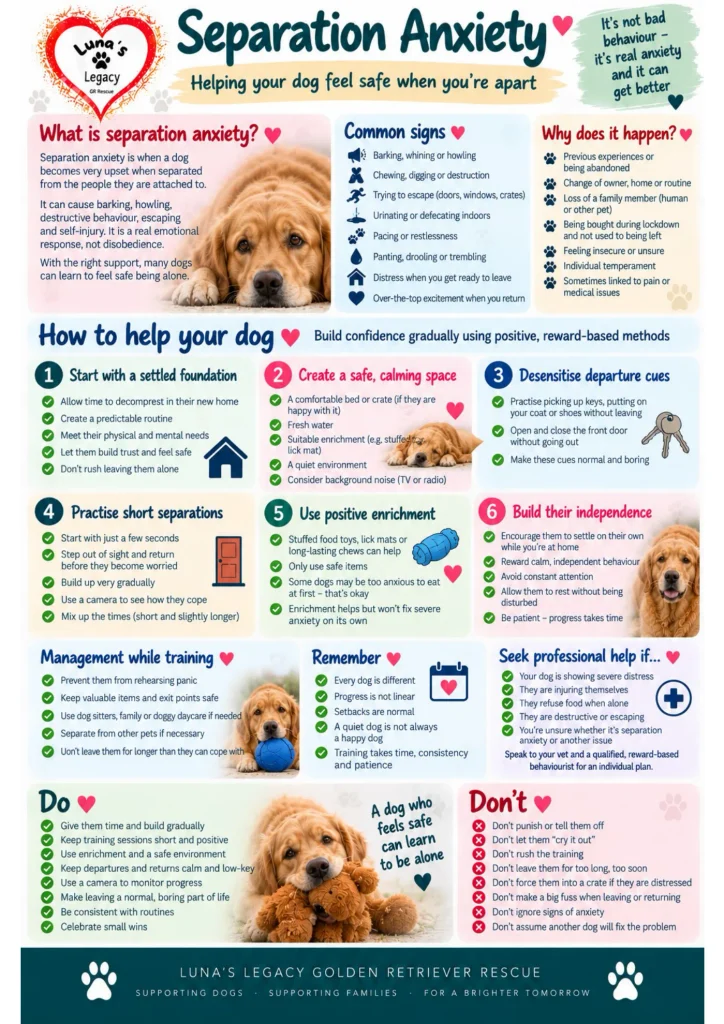
Helping Your Dog Feel Safe When Left Alone
Separation anxiety is one of the most distressing behavioural problems a dog can experience, and one that requires patience, understanding and careful management.
It occurs when a dog experiences significant anxiety or distress when separated from a person, or people, to whom they are attached.
For some dogs, this means becoming upset when their owner leaves the house. Others may struggle even when their owner moves into another room.
Separation anxiety is not bad behaviour, disobedience or a dog deliberately trying to make your life difficult. It is a genuine emotional response to being separated from someone they rely upon for security.
Dogs experiencing separation anxiety may panic, bark, howl, pace, destroy objects or attempt to escape.
In more severe cases, these behaviours can result in serious injuries, particularly when dogs attempt to escape through doors, windows or crates.
The good news is that many dogs can learn to become more comfortable with separation through appropriate training, management and, where necessary, professional support.
Separation Anxiety and Rescue Dogs
Moving into a new home is a major life change for any dog. Even dogs who have previously been perfectly happy when left alone may initially struggle after adoption. Your dog may have experienced:
- Separation from their previous family.
- Time in kennels or foster care.
- Several changes of environment.
- Disruption to their usual routine.
- Loss of familiar people or other animals.
- Uncertainty about whether their new home is permanent.
Some dogs become particularly attached to their new owners because those people represent safety and security during an unfamiliar period. This is understandable.
During the initial decompression period, your priority should be helping your dog feel secure, rather than immediately expecting them to cope with being left alone for extended periods.
However, once your dog is beginning to settle, it is sensible to introduce gentle, positive experiences of independence.
We want your dog to learn that being apart from you is safe, predictable and temporary.
Understanding Trigger Stacking Before beginning separation training, please read the section on Behaviours on this site.
A dog who has already experienced several stressful events may struggle with situations they would normally tolerate. For example, a busy walk, unfamiliar visitors and an exciting training session may leave your dog less able to cope when you leave the house.
A calm, predictable routine and sufficient rest are important foundations for successful separation training.
Recognising Separation Anxiety
Not every dog who barks or destroys something while alone has separation anxiety.
Some dogs are bored, under-stimulated or have not yet learned appropriate household behaviour.
Others react to noises, people or animals outside the home.
The important distinction is whether your dog is experiencing genuine distress associated with separation.
Common Signs
- Barking,Whining or Howling – Some dogs begin vocalising shortly after their owner leaves. This may continue for much of the absence or occur intermittently. Neighbours are often the first people to alert owners to a problem.
- Destructive Behaviour – Dogs may chew furniture, scratch doors, damage window frames or destroy household objects. Destruction concentrated around exits can be particularly concerning because it may indicate escape-related distress.
- Toileting Indoors – Some dogs urinate or defecate when left alone, even if they are normally housetrained. However, accidents can also have medical or housetraining causes and should not automatically be attributed to separation anxiety.
- Pacing and Restlessness – A distressed dog may repeatedly walk between rooms, circle, pace along a particular route or remain unable to settle.
- Panting, Drooling or Trembling – These can be signs of significant anxiety, particularly when they occur in the absence of exercise, heat or another obvious explanation.
- Attempts to Escape – Some dogs become frantic when confined or separated from their owners. They may scratch, bite or throw themselves against doors, windows or crate bars. This can cause serious injuries and requires urgent attention.
- Distress Before You Leave – Your dog may begin to show signs of anxiety when you: Pick up your keys. , Put on your shoes or coat, Collect your handbag, Prepare for work, Move towards the front door. These activities become signals that you are about to leave.
- Excessive Excitement When You Return – Some dogs greet their owners with unusually intense excitement after even a very short absence. While enthusiastic greetings are normal, they may form part of a wider pattern of separation-related distress.
How to Tell What Happens When You’re Out
One of the most useful tools is a pet camera or a simple video recording. Many dogs show distress that owners are completely unaware of. Recording your dog allows you to see:
- How quickly they settle after you leave.
- Whether they bark or howl.
- Whether they pace or appear restless.
- Whether they eat treats or engage with enrichment.
- Whether they sleep or remain constantly alert.
- Whether distress begins immediately or later during your absence.
A dog who is quiet is not necessarily a dog who is comfortable. Some anxious dogs become withdrawn or remain motionless rather than barking or destroying things. Video evidence can be extremely helpful when assessing the problem and planning appropriate training.
Why Does Separation Anxiety Develop?
There is no single cause. Potential contributing factors include:
- A change of owner or family.
- Moving home.
- Changes in household membership.
- Sudden changes in routine.
- Previous frightening experiences when alone.
- Limited experience of being left.
- Individual temperament or anxiety.
- Changes in health or physical comfort.
Dogs who have spent much of their lives with someone constantly at home may also struggle when that arrangement changes.
This became particularly noticeable in dogs raised during periods when owners were working from home and rarely leaving the house.
However, separation anxiety is not simply caused by owners spending too much time with their dogs. It is a complex behavioural condition, and dogs differ considerably in their ability to cope with separation.
Is It Definitely Separation Anxiety?
Before beginning a treatment programme, it is important to consider other possible explanations. Similar behaviours may result from:
- Incomplete housetraining.
- Medical problems affecting toileting.
- Boredom or insufficient enrichment.
- Normal adolescent chewing.
- Noise sensitivity.
- Reactivity towards people or animals outside.
- Confinement distress.
- Fear associated with a particular room or crate.
- Pain or other health problems.
A dog who is happy when left loose in a room but panics when placed in a crate may be experiencing confinement distress rather than separation anxiety. Similarly, a dog who barks at the window whenever someone walks past may be reacting to external triggers.
If your dog is showing persistent distress, a veterinary assessment is an important first step.
Preventing Separation Problems Start With Security, Not Independence
When your rescue dog first arrives, avoid immediately leaving them alone for long periods.
They need time to become familiar with their new surroundings, establish a routine and begin to trust you.
During the first few days, focus on:
- A calm, predictable environment.
- Regular feeding and toileting routines.
- Comfortable sleeping arrangements.
- Appropriate exercise and enrichment.
- Opportunities for uninterrupted rest.
- Building a positive relationship.
Once your dog is beginning to settle, introduce very short periods of separation.
The aim is to teach your dog that being alone is safe, not to test how long they can tolerate it.
Encourage Healthy Independence
You do not need to discourage affection or prevent your dog from following you around.
Being affectionate and enjoying your company does not automatically mean a dog will develop separation anxiety.
However, it is helpful to encourage your dog to relax independently.
For example:
- Provide a comfortable bed in a quiet area.
- Reward your dog for choosing to settle.
- Offer appropriate enrichment while you are nearby.
- Allow them to rest without constant interaction.
- Gradually practise moving around the house without them following every time.
- Never force your dog to remain alone if they are becoming distressed.
- Independence should develop through positive experiences.
Teaching Your Dog to Be Comfortable Alone
Step 1 – Create a Relaxing Environment
- Choose an area of your home where your dog feels safe.
- This might be a quiet room, a comfortable bed or another familiar resting space.
- Provide: Comfortable bedding. Fresh drinking water. Suitable ventilation and temperature. Safe, appropriate enrichment. A calm environment away from unnecessary disturbance.
- Some dogs find low-level background noise reassuring, although this varies between individuals.
- Avoid introducing confinement at the same time as separation if your dog is not already comfortable with it.
Step 2 – Practise Brief Separations Indoors
- Begin while your dog is calm and relaxed.
- Move a short distance away, perhaps to the other side of the room, and return before your dog becomes worried.
- Gradually progress to briefly stepping out of sight.
- For some dogs, this may initially mean only one or two seconds. That is absolutely fine.
- The important thing is that your dog remains comfortable.
- If they become anxious, shorten the separation and return to an easier stage.
- Do not wait for your dog to become distressed before returning. We want them to learn that separation is uneventful and manageable.
Step 3 – Remove the Anxiety Around Departure Cues
Some dogs begin to panic before their owners have even left. They recognise the familiar sequence of events: Shoes on. Coat on. Keys picked up. Front door opens. To help reduce this anxiety, practise these activities without actually leaving. For example:
Pick up your keys and sit down.
- Put on your coat and watch television.
- Put your shoes on and make a cup of tea.
- Open and close the front door without going anywhere.
- Pick up your bag and then carry on with normal household activities.
Over time, these actions may become less reliable predictors of separation. Keep sessions brief and stop if your dog becomes anxious. For some dogs, this stage takes days. For others, it may take weeks or longer. And yes, you may find yourself watching television in your coat and outdoor shoes rather more often than you would normally choose!
Step 4 – Introduce Very Short Departures
Once your dog is comfortable with brief indoor separations and departure cues, begin practising stepping outside.
- Start with an absence short enough that your dog remains relaxed. That might be: o One second. o Three seconds. o Five seconds. o Ten seconds. o There is no minimum time you need to achieve.
- Use a camera where possible to monitor their response.
- Return calmly and allow your dog to settle fully before repeating the exercise.
- Avoid repeatedly leaving and returning so quickly that the exercise itself becomes frustrating or stressful.
Step 5 – Gradually Increase the Duration
- As your dog becomes more comfortable, increase the length of absences gradually.
- Do not increase the time after every successful attempt.
- Mix shorter, easier separations with slightly longer ones. For example, a dog comfortable with 30 seconds might practise: o 15 seconds. o 25 seconds. o 10 seconds. o 35 seconds. o 20 seconds. These are examples only. Progress must be based on your individual dog’s response.
- If your dog begins showing signs of anxiety, return to a shorter duration.
- Progress is not measured by how quickly you can leave your dog for an hour. It is measured by how comfortably your dog copes while you are away.
How Long Will Training Take?
There is no universal timetable. Some dogs learn to tolerate short absences relatively quickly. Others require weeks or months of carefully structured training.
Dogs with severe separation anxiety may need a much longer programme supported by a qualified behaviour professional.
Avoid relying on fixed milestones such as assuming that a dog comfortable for 40 minutes will automatically cope with several hours. Every dog is different.
Using Food and Enrichment
For dogs with mild separation-related difficulties, food-based enrichment can help create positive associations with short absences. Examples include:
- Stuffed food toys.
- Lick mats.
- Appropriate food puzzles.
- Safe, long-lasting treats.
- A frozen food toy may provide an enjoyable activity while you are briefly away.
Always choose suitable ingredients and avoid foods toxic to dogs, including products containing xylitol, sometimes labelled birch sugar.
Only leave enrichment items that are safe for your individual dog to use without supervision.
Dogs who destroy or swallow parts of toys should not be left with those items.
An Important Limitation Dogs experiencing significant separation anxiety often refuse food when left alone. If your dog will happily eat a stuffed toy while you are present but abandons it as soon as you leave, this may indicate that they are too distressed to engage with it.
Food enrichment can support separation training, but it does not replace a gradual behaviour modification programme.
Should You Use a Crate?
Crates can be extremely useful for some dogs. A dog who has been positively introduced to a crate may regard it as a comfortable, secure resting place. However, a crate is not a treatment for separation anxiety. For dogs who experience confinement distress, being shut inside a crate can significantly increase panic. Dogs may injure themselves attempting to escape, sometimes breaking teeth or damaging their paws. Never assume that crating an anxious dog will help them settle. If your dog shows signs of distress when confined, do not force them to remain there. A suitably dog-proofed room or other safe arrangement may be more appropriate. Some dogs will require complete freedom from confinement during their separation training. Choose the arrangement that best meets your dog’s individual needs.
Managing Daily Life During Training
Avoid Repeated Panic
One of the greatest challenges when treating separation anxiety is preventing the dog from repeatedly experiencing the very distress we are trying to reduce.
If your dog can currently cope with only two minutes alone, leaving them for three hours is unlikely to help them learn to feel safe. It may instead reinforce their fear of separation.
Where possible, arrange alternatives while training is underway. These might include:
- A trusted family member or friend.
- A suitable dog sitter.
- Adjustments to working arrangements.
- Carefully selected dog daycare, if your dog is comfortable in that environment.
- Taking your dog with you where appropriate.
For some dogs, having another person present is sufficient. Others become distressed when separated from one particular individual, even if someone else remains with them. Your management arrangements must reflect your dog’s needs.
Exercise and Mental Stimulation
Appropriate exercise and enrichment are important for your dog’s general wellbeing. Sniffing walks, gentle training, problem-solving activities and opportunities for natural canine behaviour can help support emotional regulation. However, you cannot simply exercise separation anxiety out of a dog. An exhausted dog may still experience panic when left alone.
Avoid excessive exercise or highly exciting activities immediately before practising separation. The goal is a dog who is comfortably relaxed, not one who is physically exhausted.
When Separation Anxiety Is Severe
Some dogs experience such intense distress that even very brief separations are overwhelming. Signs of severe separation anxiety may include:
- Persistent panic or frantic escape attempts.
- Self-injury.
- Continuous vocalisation.
- Inability to settle.
- Heavy panting, drooling or trembling.
- Refusal of food during absences.
- Significant destruction around doors or windows.
- Distress beginning before the owner leaves.
These cases require an individual treatment plan. We recommend contacting your veterinary surgeon and an appropriately qualified clinical animal behaviourist experienced in separation-related problems.
Can Medication Help?
Yes. For some dogs, veterinary-prescribed anti-anxiety medication can be an important part of treatment. Medication may help reduce the intensity of anxiety sufficiently for the dog to benefit from gradual separation training.
It is not a substitute for appropriate behavioural support, but neither should it be viewed as a last resort or a failure.
For dogs experiencing significant distress, medication can substantially improve welfare. Your veterinary surgeon will advise whether it is appropriate.
What NOT to Do
- Never Punish Your Dog – Do not scold, shout at or punish your dog for barking, toileting, destroying objects or becoming distressed while you are away. These behaviours are not acts of revenge or deliberate disobedience. Punishment can increase anxiety and damage trust.
- Do Not Let Them ‘Cry It Out’ – Leaving a genuinely distressed dog to bark, howl or panic until they become quiet is not an appropriate treatment for separation anxiety. Silence does not necessarily mean the dog has become comfortable. They may simply have become exhausted or stopped vocalising while remaining distressed.
- Do Not Rush the Training – Progressing too quickly can undermine the confidence you have worked to build. If your dog struggles, reduce the difficulty.
- Do Not Assume Another Dog Will Fix the Problem – Some dogs benefit from canine companionship, but others remain distressed when separated from their human attachment figure. Getting another dog is not a reliable treatment for separation anxiety.
- Do Not Force Crate Confinement – A dog who panics when confined should not be forced to remain in a crate.
- Do Not Ignore Signs of Distress – Repeated barking, pacing, drooling or destructive escape attempts should never be dismissed as a dog simply being naughty. Investigate the cause and seek help when needed.
The Luna’s Legacy Golden Rules
- Decompression first. Allow your new dog time to feel secure before expecting prolonged independence.
- Start small. Even a few comfortable seconds alone can be a successful training session.
- Use a camera. Understand what your dog actually experiences when you leave.
- Prevent panic. Keep training absences within your dog’s ability to cope.
- Build gradually. Increase duration according to your dog’s response, not a fixed timetable.
- Keep departures calm. Avoid making leaving and returning unnecessarily exciting. Use enrichment appropriately. Food toys can help some dogs but will not resolve severe anxiety.
- Never punish distress. Anxiety is an emotional response, not disobedience.
- Seek professional help early. Severe separation anxiety can require specialist behavioural and veterinary support.
- Be patient. Building confidence and security takes time.